| Copyright © 2026 Prem Kamble |
|
Was the IAC Anti Corruption Movement of 2011 Sponsored?
A Look at the Actual Chronology |
| Related Articles |
|
Introduction
This article examines the claim through chronology and documented events. The movement was fundamentally an India Against Corruption (IAC) movement, often referred to as the Anna Movement, with Anna Hazare serving as its Gandhian and moral face. The organizational and strategic driving force behind the movement was the IAC network, which had been active long before the massive protests of 2011. IAC Existed Years Before the Anna FastIndia Against Corruption was formed in 2006 and had already been campaigning on issues such as transparency, the Right to Information, and the demand for a stronger Lokpal institution. Public demonstrations, awareness campaigns, and advocacy efforts had been taking place well before Anna Hazare's fast in 2011. Therefore, the movement did not suddenly emerge in April 2011. It evolved from years of anti-corruption activism. The Primary DemandFor understanding the Anna-IAC movement, it is extremely important to examine and understand its primary demand. The focus of the IAC movement was to pressure Parliament and the government to enact a strong Lokpal Bill—an independent anti-corruption ombudsman that could investigate allegations against public officials and politicians- a proposal that had remained pending for more than four decades despite repeated discussion. The movement was not launched in response to any single corruption allegation, nor was it directed against any particular political party or government. The very nature of this demand underscores the non-partisan character of the movement. The proposed law would have applied equally to public officials and politicians irrespective of party affiliation. The objective was not to target any party or government individually, but to create, through a strong Lokpal Bill, an institutional mechanism capable of reducing corruption across the entire political system and contribute to cleaner governance for the country as a whole. The demand itself was not new. The first Lokpal Bill was introduced in Parliament in 1968 by former Law Minister Shanti Bhushan. Although it was passed by the Lok Sabha in 1969, it failed to clear the Rajya Sabha. Over the next four decades, the bill was reintroduced repeatedly—nine times between 1971 and 2008—but was never enacted into law. It was this extraordinary delay that became the focus of the IAC movement. The activists argued that politicians across party lines had, for more than 42 years, failed to establish an effective and independent mechanism to investigate corruption in public life. It reflected a growing conviction that politicians across party lines had, for 42 years, been unwilling to subject themselves to the scrutiny of an independent ombudsman, and that strong public pressure was required to break this deadlock. The demand, therefore, was for systemic reform rather than partisan political action. The First Anna Fast: April 2011
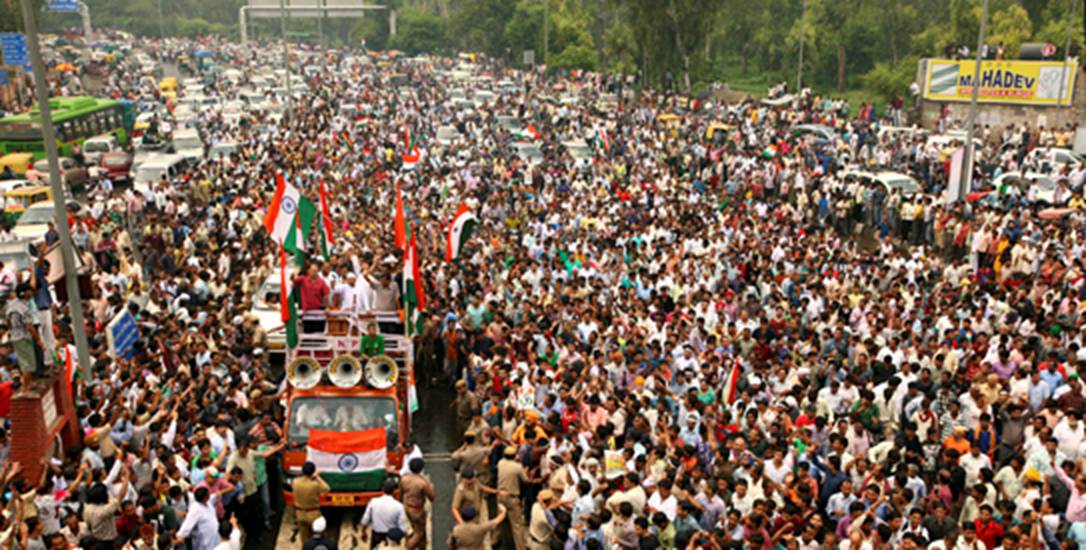
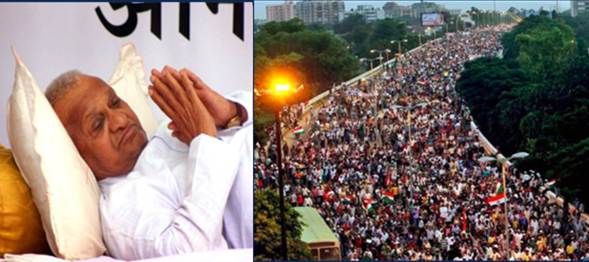
The turning point came on 5 April 2011, when Anna Hazare began an indefinite fast at Jantar Mantar demanding a strong Lokpal Bill. Anna functioned largely as the Gandhian face rather than as a political strategist. He relied on a core team — most notably Arvind Kejriwal — for messaging and tactics. Much of what Anna publicly articulated echoed positions developed and popularised by Kejriwal (Ref:Caravan Magazine) and others in IAC (for example, the ideas in Kejriwal's book 'Swaraj' were visible in most of Anna's speeches and statements). Arvind Kejriwal's position, which he repeatedly emphasized, was that the movement was against corruption, not against any particular political party. Congress, BJP and other parties were all viewed as containing corrupt elements. The movement's official position was that no political leader would be allowed to share the stage, although politicians were free to support the cause as ordinary citizens. This principled non-partisan stand was one of the reasons the movement attracted people from across ideological lines. The response from the public was very positive. People all over the country organised relay fasts and protests in support. Another important factor was Anna Hazare's Gandhian image. Gandhian methods had largely faded from general people's memories after decades, and many people had begun to doubt their effectiveness. Yet when one of the last prominent Gandhian figures came forward with a fast, many citizens felt a renewed sense of hope that peaceful moral pressure might still succeed where other methods had failed. Yet, at this stage the movement had not become the massive nationwide phenomenon that people later remember. The UPA government quickly entered negotiations and agreed to form a joint drafting committee. Anna ended his fast on 9 April 2011 after receiving assurances from the government. Negotiations with the GovernmentFollowing the April fast, several rounds of discussions took place between government representatives and Team Anna regarding the Lokpal Bill. As disagreements emerged over the scope and powers of the proposed Lokpal—particularly concerning the inclusion of the Prime Minister and senior political offices—the negotiations eventually broke down. Anna Hazare then announced another indefinite fast beginning in August 2011. The Arrest That Changed EverythingThe event that transformed the agitation into a genuine mass movement was the government's decision to arrest Anna Hazare on 16 August 2011 on the first day of his fast. The arrest triggered a huge public reaction across the country. Many citizens who had not previously participated now viewed the government's action as an attack on peaceful democratic protest. Many people hit the streets for the first time. The magnitude of public participation can be seen in the image above. Although Anna was released the same day, he refused to leave custody until he was allowed to continue his fast under acceptable conditions. The authorities were reluctant to permit an indefinite occupation of Jantar Mantar. As public outrage mounted and the crowds swelled, permission was eventually granted for Ramlila Maidan on 18 August. The venue itself reflected the scale of the movement: the crowds on the streets had become too large for Jantar Mantar. Anna continued his fast at Ramlila ground from August 19. Historically, it was this arrest and the public reaction to it— not prior orchestration, neither of IAC themselves nor any external force—that converted the campaign into a massive nationwide movement. When Anna was arrested, virtually every opposition party saw political opportunity in the government's handling of the situation. BJP leaders publicly supported Anna's demands and sought to associate themselves with the movement. However, Team Anna still officially maintained its policy that politicians would not be allowed on the main stage. In fact, during the Ramlila Maidan phase, several Team Anna leaders continued to criticize politicians in general. Kiran Bedi herself publicly mocked political leaders for saying different things in different places and even pointed toward BJP leaders present at the venue while making those remarks. This suggests that, at least publicly, Team Anna had not aligned itself with any party. The Non-Partisan Policy of the Movement
The movement's very demand—the Lokpal—was inherently non-partisan One of the defining features of the Anna movement was its insistence on remaining above party politics. A careful reconstruction of events suggests that the relationship between the movement and political parties evolved over time rather than beginning as a party -backed campaign. From April 2011 until roughly the last week of August 2011, the movement remained non-partisan and closest to Kejriwal's original vision. Its stated objective was not to defeat any political party but to fight corruption within the system itself. Its core principles were simple:
Kejriwal was among the strongest advocates of this position. During this period, neither BJP nor RSS figures exercised visible control over the movement. Arvind Kejriwal repeatedly argued that corruption was a systemic problem and that the movement should not become an instrument of any political party. The emphasis was on reforming governance rather than campaigning for or against specific parties. Throughout most of the agitation, political parties were discouraged from taking ownership of the movement. Supporters of many different ideological backgrounds may have participated, but the movement itself maintained an officially non-partisan character. This distinction is important. Participation by individuals associated with various political ideologies is not the same as organizational control by a political party. . The Late Entry of Political ForcesAs the movement gained enormous public support, it naturally attracted interest from many political and ideological groups because of its popularity. BJP leaders, RSS sympathizers, left-wing activists, supporters of Baba Ramdev, and numerous other organizations sought to associate themselves with the agitation. But the movement leadership worked to keep it independent. The non-partisan nature of the movement is a key reason for the massive public support. That is also the reason why the charge of external sponsorship does not fit the movement's early character. There is a significant difference between:
The historical record clearly shows that the movement had already become a national phenomenon before any visible political alignment emerged. Growing Tensions Within Team AnnaBy late August 2011, the movement had become a national phenomenon. BJP leaders openly supported Anna's demands in Parliament. BJP MPs and leaders increasingly visited Ramlila Maidan and expressed solidarity with the agitation. Administrative arrangements at the venue also involved authorities controlled by BJP-led civic bodies. Tensions gradually emerged within Team Anna. One group wanted to maintain strict equidistance from all political parties. Another believed that accepting support from opposition parties was tactically useful in exerting pressure on the government for Lokpal Bill. Kejriwal opposed party participation, but internal pressure and factional differences led to concessions. Many participants and later commentators have recalled that Arvind Kejriwal remained among the strongest advocates of keeping political parties off the stage, while some others within or around Team Anna appeared more comfortable accepting support from opposition groups. Some sources point to Kiran Bedi and other members who later joined BJP and were fairly rewarded. The Turning PointIt was at this stage that Anna Hazare, reportedly under pressure from some associates who were more sympathetic to accepting opposition support, became more accommodating toward BJP participation. It represented a significant departure from the movement's original insistence on keeping political parties at arm's length. My own observation, having closely followed the movement at the time, is that this was the crucial turning point that came toward the end of August 2011 or mid September when political participation became more visible. Up to that point, the movement that had already become a nationwide force, had largely succeeded in keeping the crowd united under a common anti-corruption banner. The moment BJP became visibly associated with the movement, its character began to change. Direct criticism of the Congress-led government became more prominent, and the broad anti-corruption coalition gradually began splitting along party lines. What had until then been a broad anti-corruption platform attracting people from across the political spectrum gradually started acquiring a partisan colour. Sections of the Hindu right, including several right-wing organisations and their supporters, promptly jumped in to strongly rally behind BJP. At the same time, many liberals, secularists and minority communities became increasingly uneasy, fearing that a genuinely non-partisan anti-corruption movement was being transformed into a vehicle for a broader political agenda and religious divide. A noticeable rift began to emerge between the right wing and liberal sections of society. Around this period, BJP's social-media and online campaigning machinery (IT Cell) also expanded rapidly. A new class of highly committed supporters and trollers emerged, later popularly labelled "bhakts" by their critics. Through social media, blogs and comments (sometimes nasty) on articles and news items in political e-magazines and e-newspapers, they aggressively promoted BJP's narrative, particularly the idea of the "Gujarat Model" as a template for national development. Critics argued that this narrative often glossed over important questions relating to social harmony, minority concerns and democratic institutions, while supporters viewed it as a symbol of strong governance and economic progress. Whatever one's perspective, there is little doubt that the political discourse had shifted dramatically from the movement's original focus on Jan Lokpal and systemic anti-corruption reforms. For the first time, many people who had previously marched together under a non-partisan banner increasingly began identifying with rival political and religious camps. In my view, this—not the launch of the movement itself—was the stage at which BJP began gaining significant political advantage from the agitation due to a strong religious tinge. Until then, the movement's broad appeal came from the fact that people of different political and religious beliefs could unite around a common anti-corruption agenda. Once partisan and religious considerations entered the picture, the broad unity among supporters began to fragment. Individuals who had earlier rallied around a common cause increasingly aligned themselves along political and ideological lines. The role of religion in politics remained one of the most polarizing issues in public life, often evoking deeply held convictions and producing strong support on one side and equally strong opposition on the other. The turning point, hence was Anna allowing BJP to share the stage. The movement which was apolitical so far tilted to anti-Congress govt stance. This was when a united people split on party lines - Congress supporters vs BJP supporters. This was the first time in the country that people, who were divided on religion, caste, region, language, yet had united, got so badly divided on party lines. What Happened NextThe aftermath is well known. The anti-corruption movement eventually led to disagreements within Team Anna regarding the role of electoral politics. Arvind Kejriwal and his associates concluded that systemic change required direct political participation, leading to the formation of the Aam Aadmi Party (AAP) in 2012. To clear the muck in politics, you need to jump into the muck, was their standard argument. Having finally got the limelight on Anna's stage in late August 2011, BJP was confident of forming the government in the 2013 Delhi Assembly elections - both with anti incumbency and a cloaked communal stand. Instead, AAP surprised almost everyone by winning 28 seats, while BJP won 32 and fell short of a majority. Congress, which was in govt., was reduced to just 8 seats. Congress then offered outside support to AAP, apparently expecting the inexperienced party to fail quickly. Yet the short-lived 49-day AAP government generated substantial public goodwill and laid the foundation for its landslide victory in the 2015 Delhi Assembly elections with 67 of 70 seats. After a shocking reversal at the Delhi Assembly elections of 2013, BJP stepped up its campaign against Kejriwal and Congress government (and rather virulent propaganda replete with communal flavour) and managed to dislodge Congress in the 2014 Lok Sabha elections to form the govt at the centre. The propaganda by BJP influenced quite a few Indians. It was widely felt that BJP govt was formed in 2014 by playing the communal card, not because of IAC movement, nor the so-called Gujarat model or people's love for Modi. I can vouch for the communal nature of the propaganda because I was its strongest opponent, being a strong proponent of religious unity (which is the theme of my book God in Two Minutes). This is the full chronology of events. What Does the Chronology Tell Us?My own assessment, having followed the movement closely at the time, is that the character of the agitation began to change toward the end of August 2011. Until then, Team Anna had largely succeeded in keeping political parties at arm's length and maintaining a broad anti-corruption coalition. As some opposition leaders and political sympathizers became more visible around the movement, internal differences emerged regarding whether such support should continue to be kept off the stage or strategically accommodated. Whether one views those decisions as necessary or mistaken, they marked an important turning point. The movement gradually shifted from being seen primarily as a campaign for institutional reform to becoming entangled in the larger political contest that was unfolding in the country. The subsequent political developments were complex and often unexpected. The anti-corruption movement eventually gave rise to the Aam Aadmi Party (AAP), which entered electoral politics in 2012. In the 2013 Delhi Assembly elections, AAP stunned both Congress and BJP by winning 28 seats in its very first contest, while BJP, despite emerging as the single largest party with 32 seats, fell short of a majority. Many expected AAP's first government to collapse without leaving a lasting impression. Yet the brief 49-day administration appears to have resonated strongly with a large section of Delhi's electorate. In the 2015 Assembly elections, AAP secured a historic mandate, winning 67 of 70 seats, while Congress was wiped out and BJP was reduced to just three seats. This was particularly striking because it came barely a year after BJP had swept all seven Lok Sabha seats in Delhi during the 2014 general election. These developments suggest that the political legacy of the anti-corruption movement was far more complex than is often portrayed. A significant portion of the movement's support base clearly did not migrate automatically to BJP. Instead, it fragmented in different directions and ultimately helped create a new political force altogether. Having examined the chronology of events—from the origins of IAC, to Anna Hazare's fasts, to the internal debates within Team Anna, and finally to the emergence of AAP—we can now return to the central question: Was the India Against Corruption movement conceived, launched, or controlled by RSS and BJP, or did those organisations merely seek to benefit from a movement that had already acquired enormous public momentum? The purpose of examining this chronology is not to determine who eventually benefited politically from the movement. Many political movements produce outcomes that differ from the intentions of their founders. The more relevant question is whether the movement itself was conceived and directed by RSS or BJP from the beginning. It is that claim that must be tested against the historical record. Strong Arguments Against the RSS-BJP Sponsorship TheoryThe preceding chronology allows us to evaluate the sponsorship claim on the basis of evidence rather than political rhetoric. The question is not whether BJP leaders, RSS sympathizers, or supporters of various ideological groups participated in or later benefited from the movement. Many undoubtedly did. The real question is whether the movement itself was conceived, launched, directed, or controlled by RSS or BJP from the outset. When the available facts are examined carefully, several strong arguments point to a different conclusion. It is difficult to argue that RSS or BJP initiated the movement when the IAC movement had already existed for years and the Anna movement had already become a nationwide force in 5 months because of its non partisan nature. There are several strong arguments against the claim that the India Against Corruption (IAC) movement was conceived, launched, or controlled by RSS or BJP. First: The Demand Itself was Non-partisanPerhaps the most fundamental flaw in the RSS-BJP sponsorship theory lies in the nature of the movement's demand itself. The Jan Lokpal proposal sought to create an independent institution capable of scrutinizing politicians and public officials across the political spectrum. If Parliament had failed to enact such a law despite being reintroduced 10 times over 42 years because many politicians were reluctant to submit themselves to greater scrutiny and accountability, it is difficult to explain why a political party would voluntarily initiate, fund, or sponsor a nationwide movement demanding exactly that outcome. In other words, the movement's central demand was not designed to benefit any particular party. It was designed to make all parties more accountable. A strong Lokpal would not have targeted Congress alone, BJP alone, or any other party alone. It would have subjected politicians and public officials of all parties to the same standards of accountability. The demand was therefore systemic rather than partisan. The very fact that the movement focused on an institutional reform affecting all parties equally is powerful evidence against the claim that it was conceived as a political project of any one party. Second: The Leadership's Stated Policy was Non-partisanIf RSS or BJP had conceived and controlled the movement from the outset, one would reasonably expect its slogans, speeches, and official demands to have focused on defeating Congress or promoting BJP. Instead, for most of its existence, the movement maintained a clear distinction between fighting corruption and supporting or opposing any particular political party. Arvind Kejriwal repeatedly emphasized that corruption was a systemic problem, that most parties including Congress and BJP contained corrupt elements, and that political leaders would not be allowed to share the movement's stage as representatives of their parties. The official focus remained on Jan Lokpal and broader anti-corruption reforms rather than electoral politics. This distinction between anti-corruption and anti-Congress politics is central to understanding the movement's original character. Third: The Outcome (AAP) Contradicts the Sponsorship TheoryAnother strong practical argument against the RSS-BJP sponsorship theory is what happened after the movement ended. If the movement had truly been conceived and controlled by RSS or BJP, it is difficult to explain why it eventually gave rise to the Aam Aadmi Party (AAP), which went on to become one of BJP's strongest political opponents and repeatedly defeated both BJP and Congress in Delhi Assembly elections. This does not prove that BJP supporters, RSS sympathizers, or other ideological groups were absent from the movement. Clearly they participated, especially during its later stages. However, it substantially weakens the claim that the movement itself was originally designed, directed, and controlled by RSS or BJP. Fourth: Benefiting from a Movement is not the same as Creating itIt is often argued that the anti-corruption movement ultimately contributed to the defeat of the Congress-led UPA government and indirectly benefited BJP in the 2014 general election. Even if one accepts that argument, benefiting from a movement is not the same as creating or controlling it. Many political movements produce consequences that were neither anticipated nor intended by their founders. The fact that BJP may have gained political advantage from the anti-corruption wave does not, by itself, establish that BJP or RSS conceived, launched, or directed the movement from the beginning. At most, it suggests that political forces later capitalized on a movement that had already acquired enormous public momentum on its own. ConclusionThe chronology suggests a more nuanced reality than the common political narrative.
One may legitimately argue that different political organizations benefited from the anti-corruption wave that followed. However, that is very different from claiming that the India Against Corruption movement was conceived, launched, or controlled by RSS or BJP from the beginning. The historical sequence of events does not support that conclusion. The following are among the most plausible factors that contributed to the defeat of the then government and the victory of the BJP in the 2014 Lok Sabha elections:
Some News References Caravan MagazineDawn The Guardian
|
| copyright © 2026 Prem Kamble |
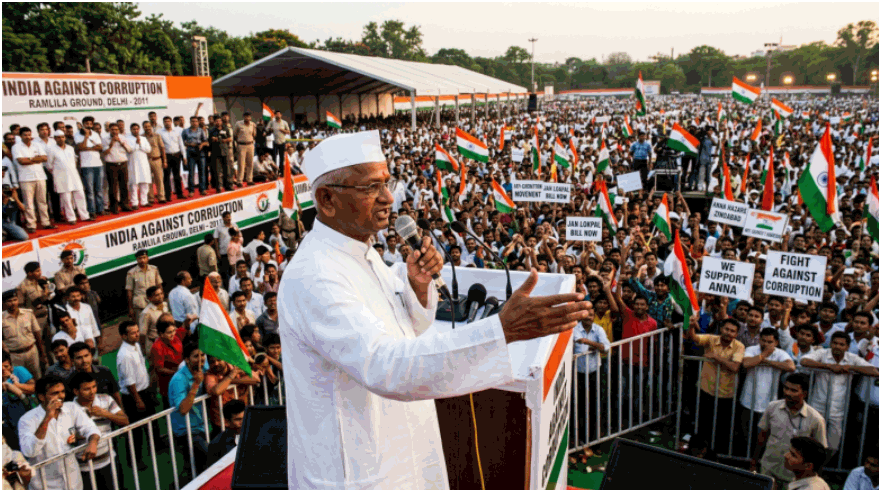
 Many people casually claim that the 2011 Anna Hazare movement was an RSS- or BJP-sponsored movement. I had very closely followed the movement and its aftermath. In order to examine this claim, we need to unfold the exact chronology of events.

comments powered by Disqus